

There’s a particular kind of wood that shows up with a story already baked into it. Not the “this came from a tree somewhere” story (although, sure, that’s true too). I mean the kind of story you can smell a little—sweet, oaky, and just barely smoky—like it spent a few years hanging out near good decisions and questionable karaoke. That’s bourbon barrel wood, and if you ask my business partner Matt G., it’s about as Kentucky as it gets. At G&H Hardwoods, we love wood that comes with a story—and bourbon barrel heads and staves have plenty of one-of-a-kind character.
Matt G. has deep ties to Kentucky, and when he talks about it, you can tell it’s not just nostalgia—it’s identity. Kentucky isn’t just a place; it’s a rhythm. It’s family and craftsmanship and hard work, and also, yes, a healthy respect for a well-made barrel. Those barrels are more than packaging in the distillery world. They’re a tool, a tradition, and a big part of what makes bourbon… bourbon.
And here’s the thing: after a barrel has done its job, it’s still packed with character. That wood has been seasoned by time, soaked with history, and shaped by purpose. Which makes it perfect for a second life in the shop—especially when you’re building with barrel heads and staves.
What are barrel heads and staves (and why do woodworkers care)?
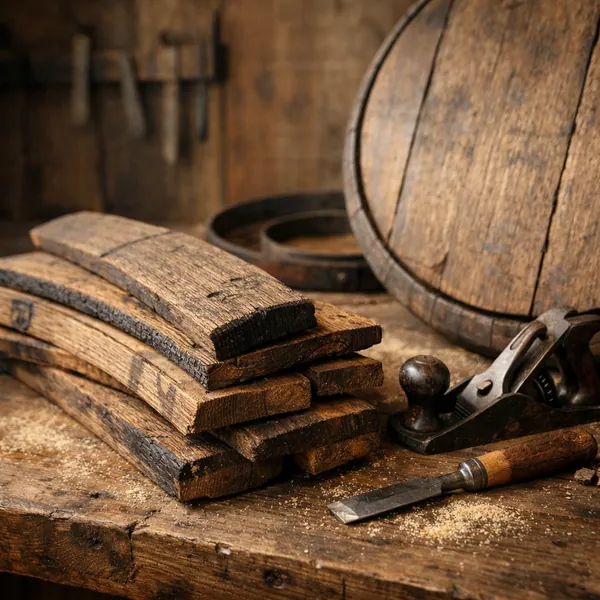
A barrel is basically a wooden engineering project disguised as a container. The staves are the long curved boards that form the sides. The heads are the flat(ish) circular ends. Together they make a tight vessel designed to hold liquid for years without falling apart—kind of like the opposite of most cardboard boxes.
But for a builder, staves and heads are interesting for a few reasons:
- White oak greatness: Most bourbon barrels are made from American white oak, which is strong, stable, and naturally rot-resistant.
- Built-in character: Expect nail holes, stamps, scuffs, darkened end grain, and color variation from use.
- Toasting and charring: The inside of a barrel is toasted/charred as part of the bourbon-making process. That means dramatic contrast: rich dark interior tones and a lighter exterior.
- Aromas and memory: Even after they’re emptied, barrel components often carry subtle scent and color—like the wood is still holding onto the good parts.
If you’ve ever built something that felt “too perfect,” barrel wood is your cure. It’s not sterile. It’s not polite. It has lived.
Quick practical tips before you start cutting
- De-nail and de-metal first: Staves and heads can hide staples, tacks, and hoop fasteners. A quick scan with a magnet (or a cheap handheld metal detector) can save your planer knives.
- Plan for movement: Barrel parts lived through humidity swings. Let the wood acclimate in your shop for a few days, and avoid locking long staves into rigid joinery without a little room to move.
- Go easy on the first milling passes: Start with light cuts and sharp blades. The charred interior is brittle, and reclaimed edges can chip if you get aggressive.
- Pick your “show face” early: The char side is dramatic and dark; the exterior is classic oak. Decide which side will face out before you start flattening so you don’t accidentally erase the look you wanted.
The barrel-head projects that just work
Barrel heads are tailor-made for pieces that want a focal point. They’re already a big, graphic shape, so they shine when you let them be the star. A few favorites:
- Wall signs and shop décor (without needing cheesy lettering to make them interesting)
- Round side tables with a barrel head as the top
- Lazy Susans that actually look like something you’d keep out
- Clock faces (because time is a big theme in bourbon and woodworking… and also because clocks are fun)
Making barrel heads behave like furniture
Barrel heads are strong, but they’re not always flat or stable enough to act like a finished tabletop on their own. For tables and Lazy Susans, it helps to mount the head to a hidden backer (plywood or a stable panel) so it stays flat, then attach your base or hardware to the backer instead of relying on the head boards and hoops.
The trick with barrel heads is structural support. They’re often held together with metal hoops and fasteners designed for barrel life, not furniture life. For a tabletop, you usually want to add a hidden substrate beneath it—something flat and stable—so it behaves like furniture instead of a stubborn circle of history.
Staves: the secret weapon for curved texture
Staves are where things get really fun. They’re curved, they’re varied, and they’re strong. They also require you to embrace the fact that you’re not working with pristine S4S boards from a rack. Staves make you pay attention.
Great stave-based builds:
- Accent panels (think: a bourbon-inspired feature wall or cabinet face)
- Picture frames with a subtle bow and texture
- Shelves with a live-rustic feel
- Chair backs or bench accents where the curve becomes a design feature
- Serving trays (especially with a darker char side showing)
Working with the curve instead of fighting it
- Use the curve as a design feature: Staves shine on chair backs, panels, and trims where a subtle bow looks intentional.
- Rip for control: If a stave’s curve is too dramatic for your project, ripping it into narrower strips makes it easier to flatten or laminate.
- Pre-drill near ends: The ends can be brittle or checked. Pre-drilling helps prevent splits when you’re fastening staves down.
Design tip: choose whether you want to showcase the char side (dramatic and dark) or the exterior side (more classic oak tones). Either way, staves look best when you don’t fight their personality. Let the curve be part of the point.
What building with barrel wood teaches you (quickly)
Barrel wood is honest work. It teaches you some things right away:
- There will be surprises. Old fasteners, hidden cracks, funky grain. It’s not defective; it’s authentic.
- Prep matters. A little extra time flattening and cleaning saves a lot of frustration later.
- Stability isn’t guaranteed. These pieces lived through cycles of humidity and use. Plan your joinery accordingly.
- Finish is everything. Barrel wood can look incredible with the right finish, but it can also look muddy if you overdo it. Light touch wins.
And honestly, that’s why we love it. It’s like working with reclaimed barnwood, but with a different kind of story—one that’s equal parts craftsmanship and culture.
Kentucky isn’t just the backdrop — it’s the reason
When Matt G. talks about Kentucky, he talks about people who make things that last. Barrels are part of that. They’re made with intention. They’re made by tradespeople. They’re made to do a hard job well.
Turning barrel heads and staves into furniture or décor isn’t about being trendy. It’s about honoring that tradition and giving it another chapter. It’s woodworking with context.
And if you’re the kind of person who loves a project with a story—if you like your materials to come with a little heritage and a little grit—barrel wood is a blast. It’s imperfect in the best way. It’s warm. It’s earned.
If you’ve got a barrel-head idea, we would love to hear it. We’re always happy to help you plan a build, pick the right companion woods, or just sanity-check the concept before you start cutting into a piece of Kentucky history.