

The Beauty That Changes
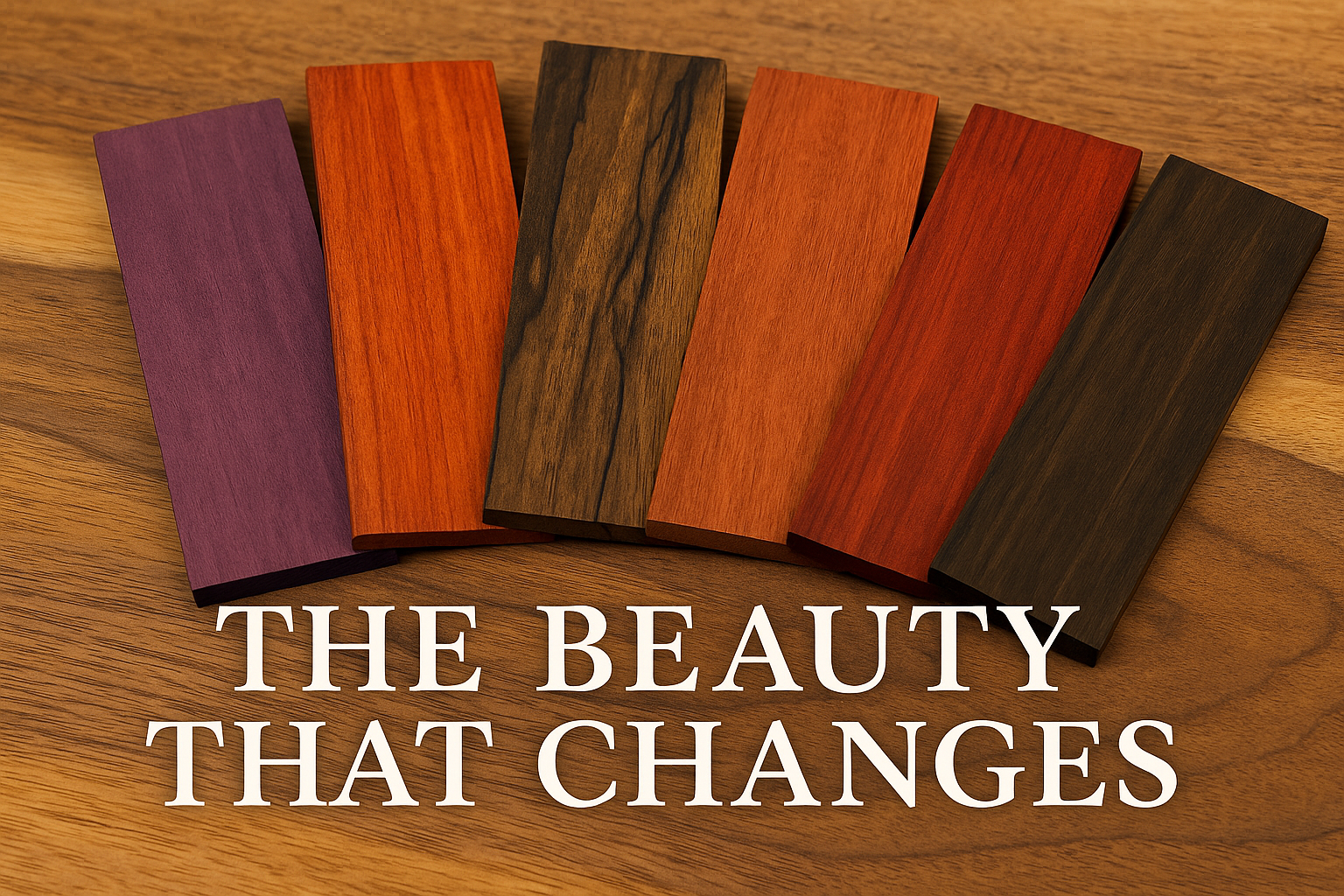
Every exotic hardwood has its own personality. That’s part of what makes them so captivating — and occasionally, a little frustrating. When you first sand and finish Purpleheart, Padauk, Ziricote, Bubinga, Bloodwood, or Wenge, the colors almost seem alive. Violet hues glow, oranges burn like embers, dark veins shimmer under the finish.
Then, over the years, that color dims and the same piece can look like a different species. This isn’t a mistake or a bad finish job — it’s nature continuing its work. Exotic woods are rich in natural oils and pigments — compounds that react with air, heat, and UV light. The result is oxidation and photodegradation: a slow, natural transformation of color.
What’s Actually Happening
When sunlight hits the surface, UV rays break down lignin (the binding polymer in wood fibers) and trigger oxidation in the extractives that give each wood its unique tone.
- Purpleheart begins deep violet and slowly warms to reddish-brown, then chocolate. The shift is mainly from oxidation — the same oxygen that hardens its surface color also ages it.
- Padauk starts out flame orange and matures into a coppery amber, then deep brown. A bit of UV exposure actually stabilizes it — too much, though, fades it fast.
- Ziricote doesn’t lose its color so much as its contrast. Those dramatic spiderweb patterns and black veins darken and blend into the base tone over time.
- Bubinga keeps its reddish body but dulls slightly, especially if oiled instead of sealed.
- Bloodwood starts brilliant crimson but can brown within months under direct light if left unsealed.
- Wenge usually darkens further, its striking grain softening into uniform chocolate tones.
Each of these species changes differently — but all respond to the same elements: light, oxygen, heat, and moisture.
How to Slow the Fade
You can’t completely stop nature, but you can definitely control how fast it moves.
- Keep it out of direct sunlight.
A window-facing tabletop will fade ten times faster than one across the room. - Use UV-resistant finishes.
Clear film finishes (polyurethane, waterborne topcoats, or marine spar varnishes) with UV inhibitors do wonders. Look for “UV-blocking” or “outdoor-rated” on the label.
At G&H Hardwoods, we carry Osmo UV-Protection Oil, which preserves the natural look and feel of the wood while filtering out ultraviolet light. It penetrates deeply, giving the wood a rich, low-sheen depth that stays true to its original color far longer than bare oil alone. - Avoid simple oil-only finishes.
Oils like tung or linseed enhance warmth but offer no UV protection. If you love that oiled look, add a topcoat after the oil cures. - Prep the surface properly.
Exotics are oily — wipe them with acetone or denatured alcohol before finishing to help adhesion and even film buildup. - Control the environment.
Stable humidity and moderate temperatures slow both oxidation and checking (tiny cracks that expose raw wood to air). - Refresh periodically.
A light scuff and recoat every few years renews the UV layer and restores color depth.
The Artisan’s Perspective
Here’s the truth: time will still win in the end — and that’s okay.
Part of woodworking, especially with exotics, is accepting that each board tells its own story. The Purpleheart desk that darkens to copper, the Padauk cabinet that mellows into warmth, the Ziricote guitar that deepens into shadow — they’re all aging gracefully, like anything well-loved.
When you understand why they change and take a few simple precautions, that beauty lasts far longer — and the transformation becomes part of the piece’s character, not its loss.
— Matt G & Matt H, G&H Hardwoods